
Why Did Scientists Start Investigating Aluminium Salts?

Why Did Scientists Start Investigating Aluminium Salts And Brain Health?
Quick answer
Scientific concern around aluminium salts and brain health did not begin with deodorants, wellness culture, or social media.
It began decades ago after several real-world incidents involving unusually high exposure to certain aluminium salt compounds, where patients developed serious neurological symptoms.
These events prompted scientists to ask an important question:
Could aluminium salt compounds accumulate in the body and affect the brain under some conditions?
That question remains debated today.
Mainstream medical organisations currently state there is no conclusive evidence linking normal antiperspirant use with Alzheimer’s disease. However, the historical incidents that first sparked concern remain an important part of the story.
Importantly, there are also some findings that are broadly accepted within the scientific literature so far:
- aluminium salts have been found to accumulate in breast tissue and in the brain
- some laboratory studies suggest aluminium salts may interact with oestrogen receptors and cellular processes
These findings do not prove causation, but they are part of the reason the scientific discussion continues.
Where did the concern begin?
For many years, aluminium salt compounds were largely viewed as biologically unimportant.
That began to change in the 1970s and 1980s after researchers observed severe neurological problems in groups of people exposed to unusually high levels of certain aluminium salt compounds.
The most influential cases involved:
- dialysis patients
- contaminated water supplies
- industrial exposure
- occupational exposure
- laboratory research into brain tissue accumulation
These events did not prove that everyday cosmetic use was dangerous.
But they did demonstrate something important:
under certain conditions, aluminium salt compounds could accumulate in the body and affect neurological function.
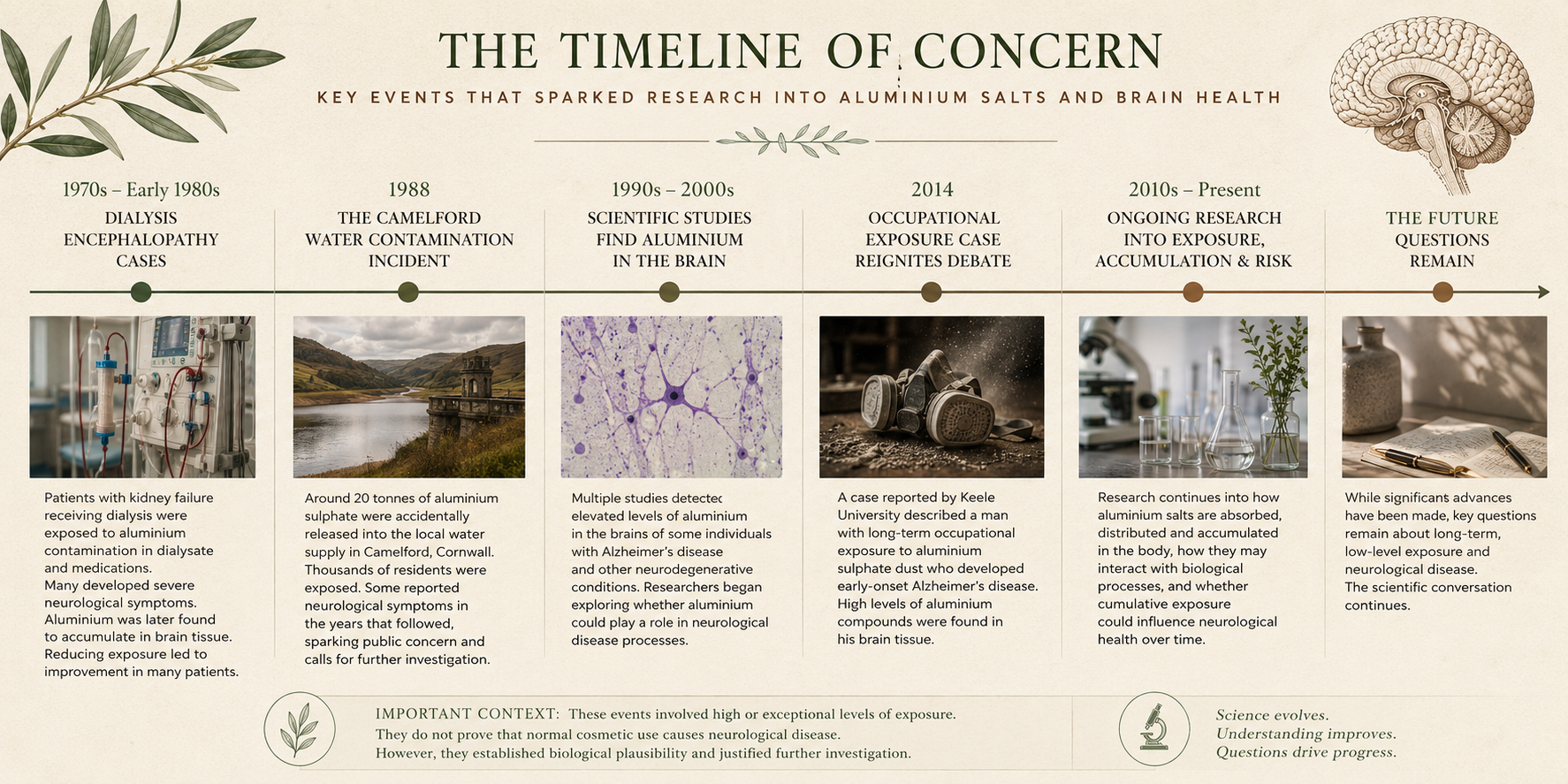
The dialysis encephalopathy cases
One of the most significant events involved kidney dialysis patients during the 1970s and early 1980s.
At the time, some dialysis fluids and medications became contaminated with aluminium salt compounds.
Healthy kidneys normally help remove excess aluminium salt compounds from the body. However, dialysis patients often had severely impaired kidney function and were unable to eliminate these aluminium salt compounds effectively.
Over time, some patients developed serious neurological symptoms, including:
- confusion
- memory loss
- speech difficulties
- muscle twitching
- personality changes
- seizures
- dementia-like symptoms
This condition became known as:
dialysis encephalopathy
or
dialysis dementia syndrome
Researchers later discovered elevated levels of aluminium salt compounds within brain tissue.
Importantly, when exposure to these aluminium salt compounds from dialysis treatments was reduced, many patients improved significantly.
This was a major turning point scientifically.
It demonstrated that certain aluminium salt compounds were not simply biologically inert substances. Under high exposure conditions, they appeared capable of affecting the nervous system.
The Camelford water contamination incident
Another event that fuelled public and scientific concern occurred in Camelford, Cornwall, in 1988.
In what became one of the UK’s most controversial water contamination incidents, approximately 20 tonnes of aluminium sulphate, an aluminium salt compound used in water treatment, was accidentally released into the local water supply.
Thousands of residents were exposed before the mistake was fully recognised.
In the years that followed, some residents reported symptoms including:
- memory problems
- fatigue
- joint pain
- concentration difficulties
- neurological symptoms
The long-term significance of the incident remains heavily debated.
Some official reviews concluded there was insufficient evidence of widespread long-term neurological harm.
Others argued that the event was not adequately investigated and warranted further study.
The Camelford case became even more controversial years later following the death of a woman named Carol Cross, who had been exposed to the contaminated water supply.
Post-mortem analysis reportedly identified unusually elevated levels of aluminium salt compounds within her brain tissue alongside an aggressive early-onset form of beta amyloid angiopathy, a condition associated with Alzheimer’s-type pathology.
Experts involved in the case stressed that the findings did not prove direct causation and that further research was needed.
However, the incident significantly intensified scientific and public interest into whether certain aluminium salt compounds could contribute to neurological disease under some circumstances.

The occupational exposure case that reignited debate
One of the most widely discussed modern cases was published by researchers at Keele University in 2014.
The case involved a man who worked for around eight years handling aluminium sulphate dust, an aluminium salt compound used in industrial insulation materials for the nuclear fuel and aerospace industries.
According to the published report, he was exposed to the dust on a daily basis, often with only minimal respiratory protection.
He later developed an unusually aggressive form of early-onset Alzheimer’s disease in his 50s, significantly younger than is typical for most Alzheimer’s cases.
Following his death, researchers identified unusually high concentrations of aluminium salt compounds within his brain tissue.
The researchers concluded that the findings justified further investigation into whether long-term occupational exposure to certain aluminium salt compounds could contribute to neurological disease in some individuals.
Importantly, this was a single occupational exposure case involving unusually high levels of inhaled aluminium salt compounds, not normal cosmetic exposure.
Even so, the case attracted international attention because it added to growing scientific evidence that aluminium salt compounds are capable of accumulating within the brain under some conditions.
Critics argued that a single case cannot establish causation.
Supporters of continued research argued that cases like this help establish biological plausibility and highlight the need for more long-term investigation into cumulative exposure.

Why did scientists begin looking at Alzheimer’s disease?
Part of the interest came from studies identifying elevated levels of aluminium salt compounds within the brains of some patients with Alzheimer’s disease.
Researchers began asking:
- could aluminium salt compounds contribute to neurodegeneration?
- could aluminium salt compounds cross the blood-brain barrier?
- could cumulative exposure matter over time?
- or were the aluminium salt compounds simply accumulating as a result of disease rather than causing it?
This distinction remains extremely important.
Finding aluminium salt compounds within brain tissue does not automatically prove causation.
But it was enough to justify further investigation.
Some laboratory studies also suggested aluminium salt compounds might:
- contribute to oxidative stress
- affect protein folding
- influence inflammatory pathways
- interfere with neuronal function
- interact with oestrogen receptors and cellular signalling pathways
Again, the science remains debated.
But by this point, aluminium salt compounds were no longer being viewed as biologically irrelevant.
Why is the issue still controversial today?
One reason is that the original cases involved exposure levels far higher than normal cosmetic use.
Critics of the aluminium salt compound-brain link therefore argue:
- dialysis patients experienced extreme medical exposure
- industrial workers faced unusually high inhalation levels
- contaminated water incidents were exceptional events
- this cannot automatically be compared with antiperspirants
Supporters of continued research argue something slightly different.
Their position is not necessarily:
“Everyday products definitely cause neurological disease.”
Instead, many argue:
“These historical incidents demonstrated biological plausibility and justified further investigation into cumulative long-term exposure to aluminium salt compounds.”
That distinction matters.
The challenge of studying long-term exposure
One of the biggest difficulties in environmental health science is time.
Neurological diseases often develop slowly over decades.
People are also exposed to countless environmental factors simultaneously, including:
- air pollution
- pesticides
- plastics
- heavy metals
- solvents
- processed foods
- synthetic chemicals
- stress
- metabolic disease
Isolating the effects of one compound is incredibly difficult.
This is one reason the debate around aluminium salt compounds has remained unresolved for so long.

Our approach at The Green Woman
At The Green Woman, we take a precautionary approach.
Current evidence does not conclusively prove that aluminium salt antiperspirants cause Alzheimer’s disease or neurological illness.
However, we also recognise that:
- aluminium salts have been found to accumulate in breast tissue and brain tissue
- some laboratory studies suggest aluminium salts may interact with oestrogen receptors and cellular processes
- long-term cumulative exposure remains incompletely understood
For us, that is enough to choose a simpler approach.
This is one reason products such as Fit Pit are made without aluminium salts. Read more in our blog 'What is the healthiest deodorant to use?'.
Prevention-focused organisations such as Breast Cancer UK also encourage people to reduce exposure to certain synthetic chemicals where practical. In their A–Z Chemicals Guide, they advise avoiding aluminium salts in antiperspirants where possible as part of a wider precautionary approach to reducing chemical exposure.
Ultimately, this conversation is not just about one ingredient.
Modern humans are exposed daily to hundreds of synthetic chemicals through:
- cosmetics
- fragrances
- plastics
- cleaning products
- pesticides
- food packaging
- household products
- pollution
No single product is likely responsible for chronic illness by itself.
But many people are increasingly asking an important question:
What happens when these exposures accumulate over decades?
That cumulative “chemical loading” question remains one of the most important and still unresolved areas within environmental health science today.
And for many people, reducing unnecessary exposure where reasonably practical simply feels like a sensible place to begin.
Other Green Woman articles you might like:
Are Aluminium Antiperspirants Safe? What The Science Really Says
What is the Healthiest Deodorant To Use?
Detox Your Bodycare: Why What You Put on Your Skin Matters
Further Research
1. Dialysis encephalopathy and aluminium exposure
A key early paper on dialysis encephalopathy, showing higher brain aluminium levels in patients who died with dialysis-associated encephalopathy syndrome.
Read: The dialysis encephalopathy syndrome
2. The Camelford water contamination incident
A peer-reviewed retrospective study into people exposed to drinking water contaminated with 20 tonnes of aluminium sulphate in Camelford, Cornwall.
Read: A retrospective study of the Camelford water incident
3. Occupational exposure and early-onset Alzheimer’s disease
A published case report about a man with long-term occupational exposure to aluminium sulphate dust who later developed early-onset Alzheimer’s disease, with elevated brain aluminium levels reported.